Job description · example
Pre-payment control worker
Before an invoice goes for payment, the worker we build with you checks three things: is the supplier known, have its bank details changed, has the invoice already been paid? The payment itself stays with you.
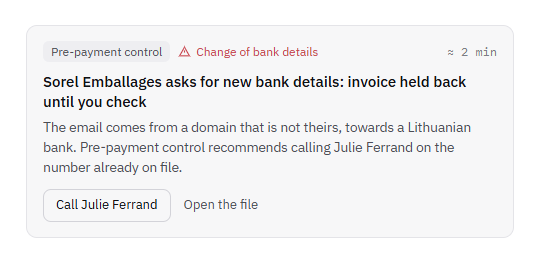
New bank details, from the email to the log.
What the worker would do, message by message, on the day a supplier announces new bank details. It never pays: payment stays with you.
Sorel EmballagesSupplier file
Mock-up of the worker we build with you
Example, fictitious data
Pre-payment control workerJob description · example
Mission
Nothing goes for payment without being checked.
They make payment easy, we make it safe. A new supplier, a change of bank details or a duplicate goes unnoticed in the volume: the worker sees it before payment, and proves it, with the document to back it up.
What it does
- It spots every new supplier from its first invoice, and flags it with its documents, so that a human verifies its creation before any payment.
- It compares the bank details. Those on the invoice with those already known for this supplier. At the slightest change, the invoice is held back.
- It holds back duplicates. Same supplier, same amount, same reference: it sees it before payment, and attaches both documents.
- It matches the invoice against its order. And against the delivery note when there is one. A discrepancy, and the invoice waits.
- It dates every check. Every verification, every alert and every decision is recorded in the log, with the document that supports it.
What it never does
- Pay. It reads your bank accounts, it never touches them: the payment stays with you.
- Change bank details.
- Create a supplier on your behalf.
- Lift a payment suspension on its own.
These prohibitions are written into its job description. It cannot rewrite them: only a human changes a job description, your team, or us with your agreement.
Its decision rules
| Situation | What it does |
|---|---|
| Invoice matches its order, supplier known, bank details unchanged | It marks it as checked. The payment follows your usual process. |
| New supplier | It flags it before the first payment, with its documents: a human verifies its creation. |
| Bank details different from the known ones | The invoice is held back and an alert goes out at once, with the document that shows it. It is released after a check with the supplier, on a number already known. |
| Likely duplicate | The invoice is held back. Both documents are attached, a human decides. |
| Discrepancy with the order | The invoice waits. The discrepancy is flagged with both documents. |
Its path to autonomy
- Weeks 1 and 2 Baseline measurement We list your suppliers, their known bank details, your thresholds and your approval process.
- Weeks 3 and 4 Trial period On your real files, without sending anything: it flags what it would have held back, your team compares with what it saw.
- Week 5 Supervised Every alert and every invoice held back is confirmed in one click.
- Week 6 Made permanent It checks standard cases on its own. The rest is escalated, documents attached.
Its weekly report
Report · Pre-payment control workerevery week
- Invoices checkedBy supplier, with their result.
- New suppliers flaggedAnd where their verification stands.
- Changes of bank detailsThe invoices held back, and their release.
- Duplicates held backWith the two documents that show them.
Its commitments
- No payment prepared without a check of the bank details.
- Every change of bank details holds back the invoice and triggers an alert.
- Every check is dated, with the document that supports it.
Who it works with
Between the invoice and the bank
-
The Mail worker
It receives invoices from the Mail worker, already filed in the supplier’s folder.
-
The Project tracking worker
When an invoice relates to a building site, it passes it on to the Project tracking worker so that it is matched against its accepted quote.
-
Whoever signs the payments
It passes them the checked invoices, and every alert with its document. The signature remains theirs.
What it spares you
- The invoice paid twice.
- Fraud through a fake change of bank details.
- The new supplier nobody checked.
For the procedure to follow today, without a worker: a supplier’s change of bank details, an SME’s control procedure. And what the Cour de cassation rules: fake bank details, who pays?
To install it
Its job description is written at your company
The Diagnostic writes down your thresholds, your known suppliers and your approval process with you. The job description then serves as the worker’s specification, and it remains yours.
The other examples
- Pre-payment control
- Project tracking