On a single task, AI saves up to 70%. Across the whole company, around 4%1.
Time is lost between tasks. That’s where we work.
Anthelixa tells you where AI will save you time. Then we design AI workers with you, we run them under your control, and your teams work alongside them on the same files. The decision remains yours.
Why between tasks?Already know what you are looking for? An AI audit A custom worker
The problem was never the technology.
An AI that speeds up every task does nothing about the waiting between people, or between tools. And four companies in five measure no gain at all1. What needs reworking is how the work is organised.
-
The firm without a product
It leaves you a report.
A good model can redo a report in a few hours. What cannot be redone is a system running in your company.
-
The vendor without integration
It leaves you a tool.
Nobody connects it. Your rules and your exceptions are left to you, and the project dies at the pilot stage.
-
Anthelixa
We advise, then we make it run.
What we recommend, we build on your rules and connect to your tools: a worker with a job description, a trial period and a record that cannot be rewritten. Then we measure the result in your company, before and after.
What a worker never does, and what it does instead
- Pay an invoice: never. It reads your accounts, it never touches them: the payment stays with you.
- Send an email on your behalf: never. It prepares the draft, a human sends it.
- Create a quote without your approval: never. It prepares the card: the quote is created only after your approval.
- Change its own rules: never. Only a human changes its job description.
- Erase a line from the log: never. Every change stays there: the log accepts additions only.
Overnight, they work.
Digital colleagues, the workers, take on the tasks nobody has time to finish, and pass each file to whoever handles it next. They follow rules written with your teams, and record everything they do.
- 22:04Mail64 documents received, sorted and filed in the right folder. Two set aside for checking.
- 23:17Pre-payment control23 invoices matched against their purchase orders. One duplicate held back before payment.
- 01:40Pre-payment controlSorel Emballages is asking for new bank details. The invoice is held back until you have checked.
- 03:02Project trackingJoinery package: the invoice exceeds the accepted quote. The payment is on hold, and the discrepancy is flagged with both documents.
- 05:58Project tracking12 invoices matched against their quotes. The amount left to pay is up to date, package by package.
Example, fictitious data.
07:42
In the morning, you decide.
Eleven decisions are waiting for you, each with its file ready: about nine minutes. Everything else is done, and recorded in a log your chartered accountant can review.
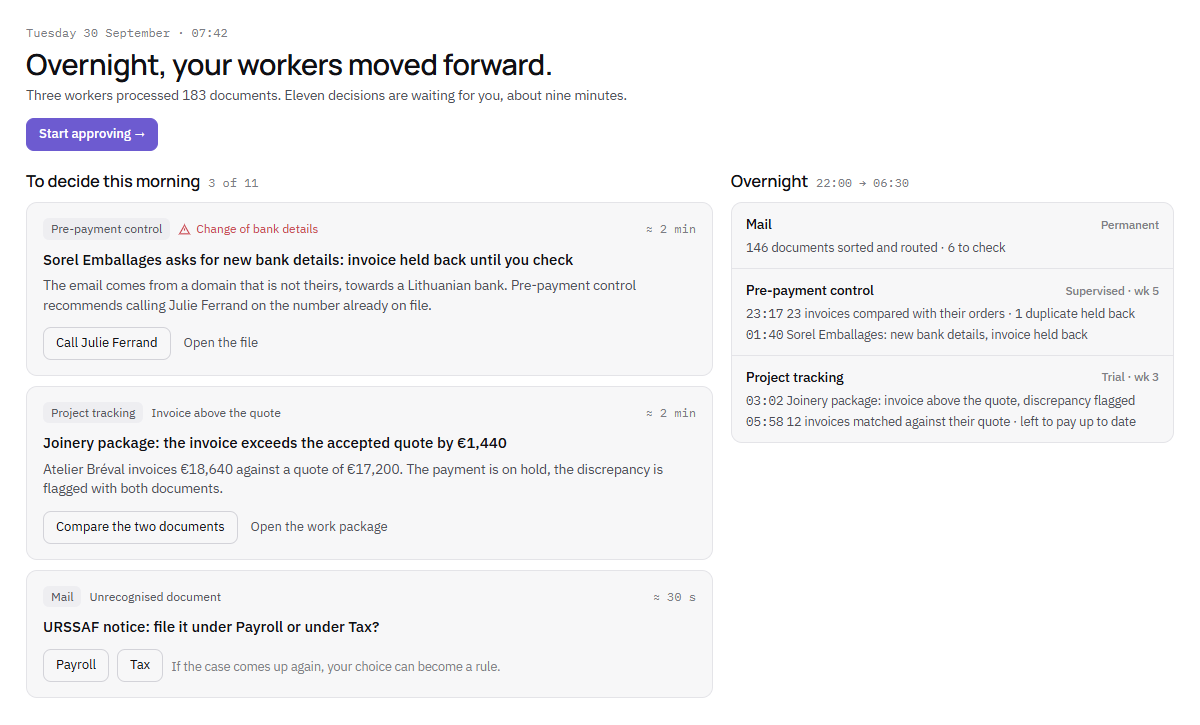
Where your teams and the workers pass the baton.
The morning screen is the platform. Not one more tool to fill in: the place where work arrives done, and where the decisions are waiting for you.
One invoice, two ways of working
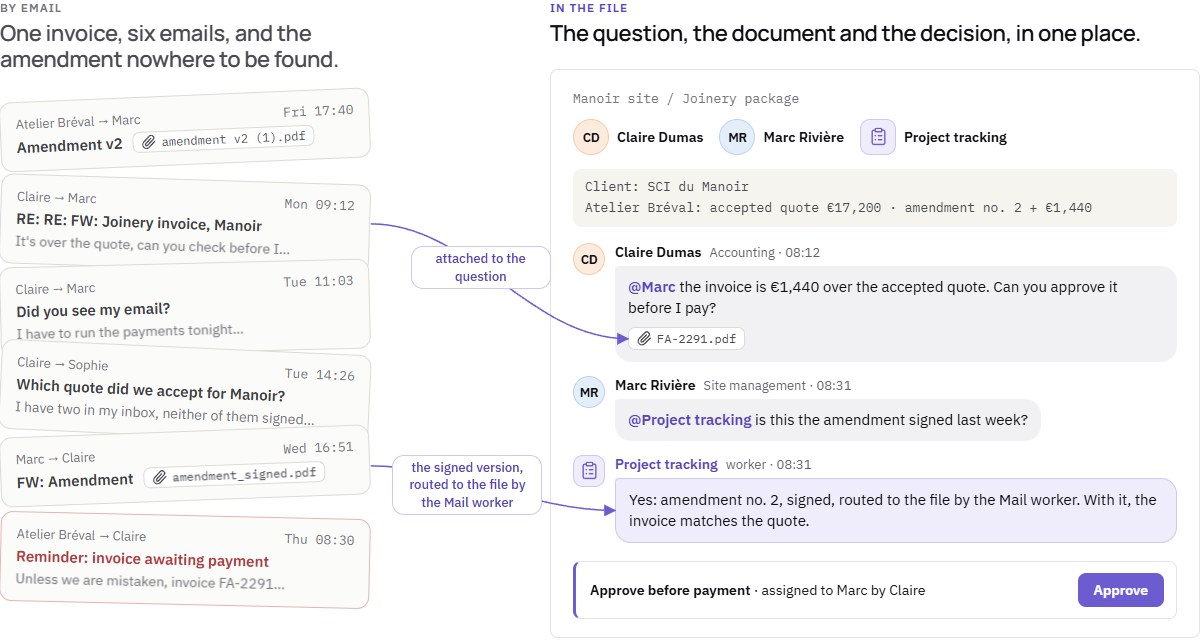
Nobody forwards an email or hunts for the right version: the worker finds the document in the file, Marc decides. Everything is recorded in the log.
Between your teams
- Your colleagues write to each other in the file, not by email: the question, the document and the answer stay together.
- Every task is assigned to someone, and everyone sees what is waiting for them.
Between your teams and the workers
- Your teams assign a task to a worker, and the worker assigns one to a person.
- When it is waiting for someone, it stops, then resumes on its own.
- You mention it in a file, and it replies in the thread.
What remains
- In the morning, the decisions are waiting, each with what the worker has prepared.
- Everything is recorded in a log that cannot be rewritten.
- On the day of a dispute, the file is frozen.
Connected to your email (Gmail or IMAP), your documents and your accounting software (Pennylane). An attachment can be found there by what it contains, even when scanned: find a document.
Manoir siteFile
- CD
- MR
Example, fictitious data
Consulting and audit
Know where AI will pay off. Then see it run in your company.
For leaders who have to do something with AI, and refuse to pay for one more pilot. From 10-employee SMEs to mid-sized companies.
-
The pilot that never goes into production.
Without measurement, a pilot convinces nobody to go further. We measure before we recommend, and again after we install.
-
The tool pushed on you.
An audit run by a software vendor always ends with its software. Ours can conclude “do nothing”, and says so.
-
Your data in a consumer tool.
Your teams may already be using AI with no framework. We set the rules: where your data is, who reads it, what is allowed to leave.
Three formats, fixed fee, with a deliverable you keep.
-
Diagnostic
1 week
One process, from the first document to filing. For the SME that knows where things get stuck. The way in.
Fully deducted if you install a worker within the following month.
-
Strategic AI audit
2 to 4 weeks
Three to five departments, all four axes. The complete scoping of an SME.
-
360 audit
4 to 6 weeks
Several divisions, data and governance. For mid-sized companies.
Consulting is never sold on time spent. Each format has a price set before we start.
And if action is needed
-
Rule design
Your thresholds, your exceptions, your sensitive clients, written in a format your teams can review and change on their own. This work belongs to you, worker or not.
-
Custom workers
Designed with you, built on your rules, at work on the platform and connected to your tools.
AnthelixaStrategic AI audit, extract
Summary: three findings
- 1
14 hours a week preparing responses to tenders, from the same documents.
Custom build: a dedicated workflow, each response approved by the sales team.
- 2
3 AI tools used by the teams, with no shared rule on data.
Needs a framework: what can leave, what never leaves, who approves.
- 3
Key account service, handled by hand.
Do not automate: the relationship is worth more than the time saved.
Recommendation
A custom workflow for tenders, a Pre-payment control worker, AI usage rules for the whole team. For each, a measurement before and after.
An audit that cannot conclude “do nothing” is not an audit.
In the extract, the third finding says so: do not automate. And when the audit recommends action, you do not have to look for someone to carry it out: we build it, we run it, we measure.
Custom workers
You started a company. Not an admin department.
Workers designed with you during the Diagnostic, built on your rules, at work on your real files from their trial period.
Today
A week of chasing
With your workers
The next morning, in one click
What is lost between tasks today.
-
Three places
for the quotes, invoices and payments of a single project. Nobody knows what is left to pay on each work package.
The Project tracking worker matches each invoice against its accepted quote and keeps track of what is left to pay, package by package.
-
60% of SMEs
suffered at least one attempted fraud in a year. In 40% of cases, an attempt succeeded2.
The Pre-payment control worker holds back the invoice and alerts you before payment, with the document that shows it.
-
Only one person
knows your thresholds, your exceptions, the clients to handle with care. The day they leave, your rules leave with them.
Each worker has a written job description, which your team reviews and edits. It stays with you.
On 1 September 2027, your invoices change format.
Since 1 September 2026, every company must be able to receive electronic invoices. From 1 September 2027, SMEs will also have to issue them. A non-compliant invoice costs a €50 fine, up to €15,000 a year3.
The reform changes the format. It does not do the work. Your approved platform receives the invoice; the workers sort it, check it before payment and match it against its order or quote.
Three example workers.
| The problem | What the worker does | What you keep |
|---|---|---|
| Documents sit idle in a shared inbox, and nobody knows who handles what. | It sorts, files and passes each document to the right recipient. | Whatever calls for judgement. |
| Pre-payment control | ||
| A new supplier, a change of bank details or a duplicate slips through with the rest. | It holds back the invoice and raises an alert before payment, with the document that shows it. | The payment. |
| Project tracking | ||
| Quotes, invoices and payments live in three places. | It matches each invoice against its accepted quote and keeps track, for each work package, of what is invoiced and what is left to pay. | Every approval and every payment. |
These examples show what a worker does; they are not a fixed catalogue. We start from a standard job description and adjust it to your rules: it is quicker, and cheaper, than starting from scratch.
Built once. Better every month.
AI changes every week. You do not have to keep up: that is our job.
How you buy it.
- Diagnostic
- Fixed feeFully deducted if you install a worker within the following month.
- Building a worker
- Fixed fee, set at the end of the DiagnosticFrom the job description to being made permanent.
- Subscription
- Monthly, per worker, depending on the volume and the complexityThe platform is included: you pay for the work, not the tool.
- Commitment
- Twelve monthsAt the end of the term, you renew or you stop. Your job descriptions, your rules and your log remain yours: we hand them over to you in an open format, whether or not you continue.
Every price is set before we start. Never on time spent.
Everything we install is hired.
A custom worker joins you like a new colleague: a job description, a trial period, then being made permanent. You see what it does before it does it.
Weeks 1 and 2
Baseline measurement
We write its job description with your teams: what it does, what it never does, when it hands over.
Weeks 3 and 4
Trial period
It works on your real files without sending anything. Your team compares with what it did itself.
Week 5
Supervised
It acts, and its actions go through one-click approval, entrusted to the person you have designated.
Week 6
Made permanent
It handles standard cases on its own, within your rules. Everything else is escalated, with its file ready.
Six weeks for a worker that starts from a standard job description. When it has to start from scratch, the timeline depends on the number of processes: it is set at the end of the Diagnostic. The method in detail
And you stay in control of your data.
We do not promise that nothing ever leaves. We promise that you know where your data is, who reads it, and what the workers are allowed to do. Security and data
- Hosted in France.
- Open models, installed locally. An external model only with your written agreement.
- Your data trains no model without your written agreement.
- A log that cannot be rewritten, readable by your chartered accountant.
“Companies do not need one more tool. They need the work done.”
Yann Grumbach, founder and president of Anthelixa
More than ten years helping clients with their data and digital challenges, tied to their business processes: from finance to sales, from stock management to banking. Then AI, naturally: former partner and managing director of an AI consulting and product studio.
Every request is read, and we call you back. If AI does not save you anything, we tell you so.
Your questions
Will my teams be replaced?
No. The worker takes the task, not the job. It handles data entry, checks and filing. Your teams keep the decision, the relationship with your clients and suppliers, and the cases that call for judgement.
The rules it applies are written with them.
What happens if it makes a mistake?
Everything is designed so that an error shows before it costs anything. During the trial period, it only proposes: a human compares. After that, anything that leaves your company goes through approval.
What it must never do is written in its job description, and a doubt is flagged, never settled. Every action is recorded in a log that cannot be rewritten: you know what it did, and when.
Do we need to change our software?
No. We complement business software; we do not replace it. The workers work on top of your software and in your email: they do the work that gets lost between tools.
Before a worker is installed, the Diagnostic sets out exactly what connects, to what, and with which permissions.
Isn’t a platform just one more tool?
No. It replaces chasing emails, the “did you see my request?” messages and the tracking spreadsheets. Nobody re-enters anything in it: the workers bring in the work done, and your teams make the decisions there.
Where is my data?
In France, on a server we operate ourselves. Your data is processed there by open models installed locally. An external model is only called with your written agreement: we then tell you who its provider is. Your data is not used to train any model without your written agreement.
The knowledge base is in Markdown, an open format you can read without us.
Anthelixa is a young company. Why should we trust you?
Because you do not have to take our word for it. The audit is sold at a fixed fee, with a deliverable you keep. A worker spends two weeks on trial without sending anything: you judge on the evidence before it acts.
And your job descriptions, your rules and your log remain yours: we hand them over to you in an open format, whether or not you continue.
How much does it cost?
Consulting is always sold at a fixed fee, with a named deliverable. Never on time spent. Each format has a price set before we start.
The Diagnostic is charged at a fixed fee. It is fully deducted if you install a worker within the following month.
A custom worker is built at a fixed fee, then runs on a monthly subscription, per worker. The platform is included. You know both before you start.
How long does it take?
A strategic AI audit: a few weeks, depending on the number of processes to measure. A custom worker: six weeks when it starts from a standard job description, from the baseline measurement to being made permanent.
When it has to start from scratch, the timeline depends on the number of processes: it is set at the end of the Diagnostic.
And if I want to stop?
The audit commits you to nothing else. A worker subscription runs for twelve months. At the end of the term, you renew it or you stop.
In every case, your job descriptions, your rules and your log remain yours: we hand them over to you in an open format, whether or not you continue.
Thirty minutes to know where to start
What happens next
Consulting and custom workers are for companies from 10 employees up to mid-sized companies. Below that, good software is often enough.
Sources
- ILO, The Aggregation Paradox of AI, C. Chan and K. Shedania, May 2026. The 4% comes from an EIB working paper covering more than 12,000 companies; “four companies in five” from a survey of nearly 6,000 executives in more than 20 countries (Yotzov et al., 2026), both cited by the ILO.↑↑
- Allianz Trade and Odoxa, baromètre de la fraude 2026 (in French), June 2026.↑
- Loi de finances pour 2026, sanctions de la facturation électronique (in French).↑