Job description
Mail worker
The Mail worker we build with you reads the administrative inbox, recognises each document, files it in the right folder and passes it to the right person or the right worker. Anything that fits no category is flagged to you.

Mail workerJob description · example
Mission
Sort the administrative inbox and route each document.
Invoices, payment due notices, reminders received, letters from public bodies: everything arrives in the same place, and nothing should sit there. It is the front door: the other workers start from what it sorts.
What it does
- It reads the administrative inbox. The shared address where invoices, notices and letters arrive, and paper letters once scanned.
- It recognises each document. Supplier invoice, credit note, statement, payment due notice, reminder received, letter from a public body.
- It files it in the right folder. With the sender, the date, the amount and the due date when there is one.
- It passes it to the right recipient. The Pre-payment control worker for an invoice, the person or worker concerned for a customer’s reply, a person for the rest.
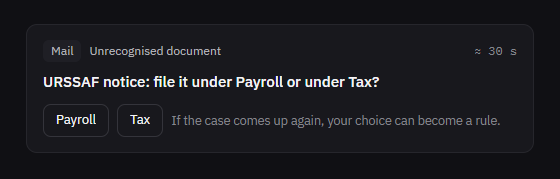
- It flags anything that fits no category. Rather than filing it at random.
What it never does
- Reply to anyone outside on your behalf.
- Delete a message or a document.
- Pay, sign, accept a quote or terms.
- Decide on anything that fits no category.
These prohibitions are written into its job description. It cannot rewrite them: only a human changes a job description, your team, or us with your agreement.
Its decision rules
| Situation | What it does |
|---|---|
| Document recognised, recipient known | It files and routes it. |
| Doubt about the type of document or its recipient | It waits. A human decides. |
| Letter from a public authority, a lawyer, a judicial officer | Flagged as a priority, never handled alone. |
| Notice of a change of bank details | Immediate alert. Nothing is taken into account without a human check. |
| Document received twice | Filed once, the duplicate flagged. |
Its path to autonomy
- Weeks 1 and 2 Baseline measurement We list what arrives in the inbox, who deals with it today, and the routing rules that are written down nowhere.
- Weeks 3 and 4 Trial period On your real files, without sending anything: it proposes a folder and a recipient for each document, your team compares with what it did.
- Week 5 Supervised It files and routes, each routing approved in one click.
- Week 6 Made permanent It handles the documents it recognises on its own. The rest is escalated.
Its weekly report
Report · Mail workerevery week
- Documents receivedBy type: invoices, notices, reminders, letters.
- Documents routedBy recipient, worker or person.
- Documents pendingThose awaiting a decision, and since when.
- Unrecognised documentsTo decide whether they deserve a rule.
- Priority flagsPublic bodies, lawyers, judicial officers, changes of bank details.
Its commitments
- Every document has a recipient or a flag.
- Nothing is deleted.
- Handling time measured by us, before it arrives and after.
Who it works with
The entry point for the others
-
The Pre-payment control worker
It passes the invoices received to the Pre-payment control worker, filed, with their due date.
-
The person or worker concerned
It passes your customers’ replies to the person or worker concerned: disputes, promises, payment notices.
-
Your teams
They receive what is theirs, and decide on what it could not classify.
What it spares you
- The invoice left sitting in an inbox nobody reads.
- The payment due notice you discover along with the penalty.
- The document you hunt for three weeks later.
For a document already received, Anthelixa’s search already reads the content of attachments today: find a document.
Measured results
What it has measured at our clients
To install it
Its job description is written at your company
The audit lists what arrives in your inbox and writes the routing rules. The job description then serves as the worker’s specification, and it remains yours.