You see what it does before it does it.

A worker is not installed like software. It is recruited: we measure the work to be handed over, we put it on trial, we validate what it does, then we make it permanent. It works on your real files from week three, and it is made permanent in week six. Not a year-long project.

  1. Weeks 1 and 2Baseline measurementDiagnostic, job description, connection to your tools.
  2. Weeks 3 and 4Trial periodOn your real files: the worker proposes, a human compares. Nothing goes out.
  3. Week 5SupervisedIt acts, each action approved in one click.
  4. Week 6Made permanentIt handles standard cases on its own. The rest is escalated.
The six weeks of a recruitment: baseline measurement, trial period, validation, made permanent.

Week by week

A recruitment, not an installation

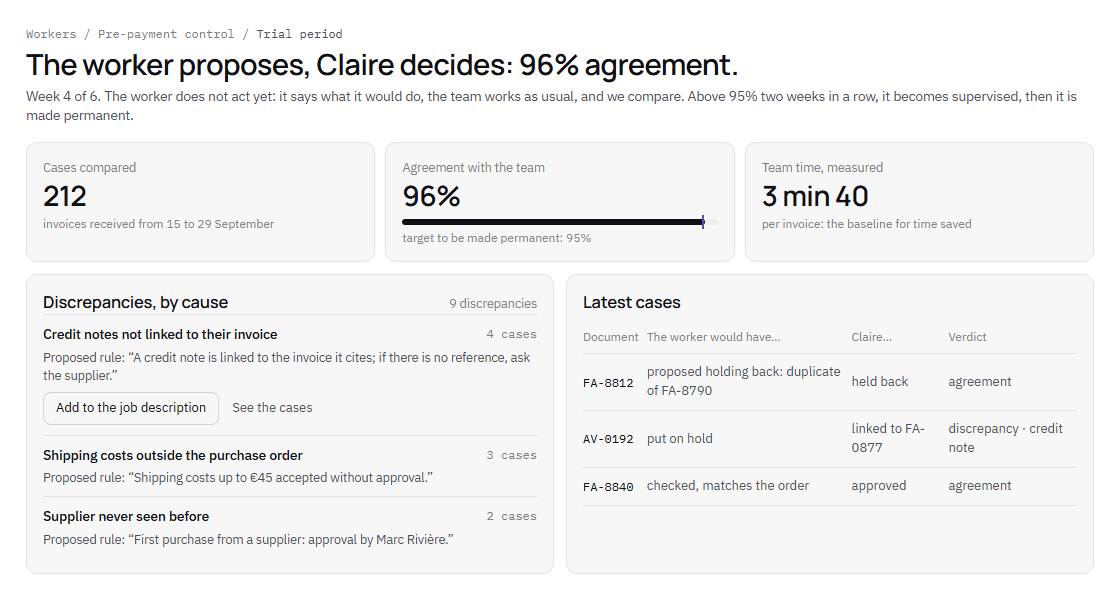
The trial period of the Pre-payment control worker: 96% agreement with the team on 212 invoices compared, above the 95% target. The remaining discrepancies are classified by cause, with a rule proposed for each, and the latest cases include a duplicate the worker proposes to hold back.
Example, fictitious data

Weeks 1 and 2

Baseline measurement

What happens

Interviews with the people who do this work today, observation of the real flows, reading of the documents. We write the job description: mission, what it does, what it never does, decision rules, thresholds. We connect your tools, read-only first.

What you do

You review and validate the job description. You designate the person who will validate its actions.

What comes out of it

The validated job description. The baseline measurement, for comparison later.
Weeks 3 and 4

Trial period, without sending anything

What happens

The worker works on your real files, alongside your team, without sending anything. It proposes, a human compares with what was done. Each discrepancy is read and its cause corrected: a badly written rule, a worker error, or a team habit that nobody had written down.

What you do

You look at the discrepancies. You settle those that call for a decision.

What comes out of it

Corrected rules. The list of cases it will never handle on its own.

Week 5

Supervised

What happens

It acts, and its actions go through one-click validation, entrusted to the person you have designated, with the file in front of them.

What you do

You validate, or you correct.

What comes out of it

Proof, action by action, that it does what its job description says.

Week 6

Made permanent

What happens

It handles standard cases on its own, within the rules you have set. The rest is escalated, with the file prepared. The weekly report begins.

What you do

You decide what is escalated. You read the report.

What comes out of it

A worker in production. A first comparison with the baseline measurement.

And afterwards

Rules that evolve with you

Every week, a report: what it has done, what awaits your decision, what has been measured.

The rules live in the job description, in French: you change them yourself, without any development. A case that comes up often becomes a written rule.

What Anthelixa does

Your invoices, your projects and your mail, prepared overnight, validated in the morning by your teams

A worker is a digital colleague that takes charge of a chain of tasks: the mail, checking invoices before payment, tracking a project. Anthelixa installs it in a shared workspace where the workers pass files to one another, and to and from your teams. Every exchange is written there, every document time-stamped, every action traced. Your teams keep the decision.

Everything goes through the file

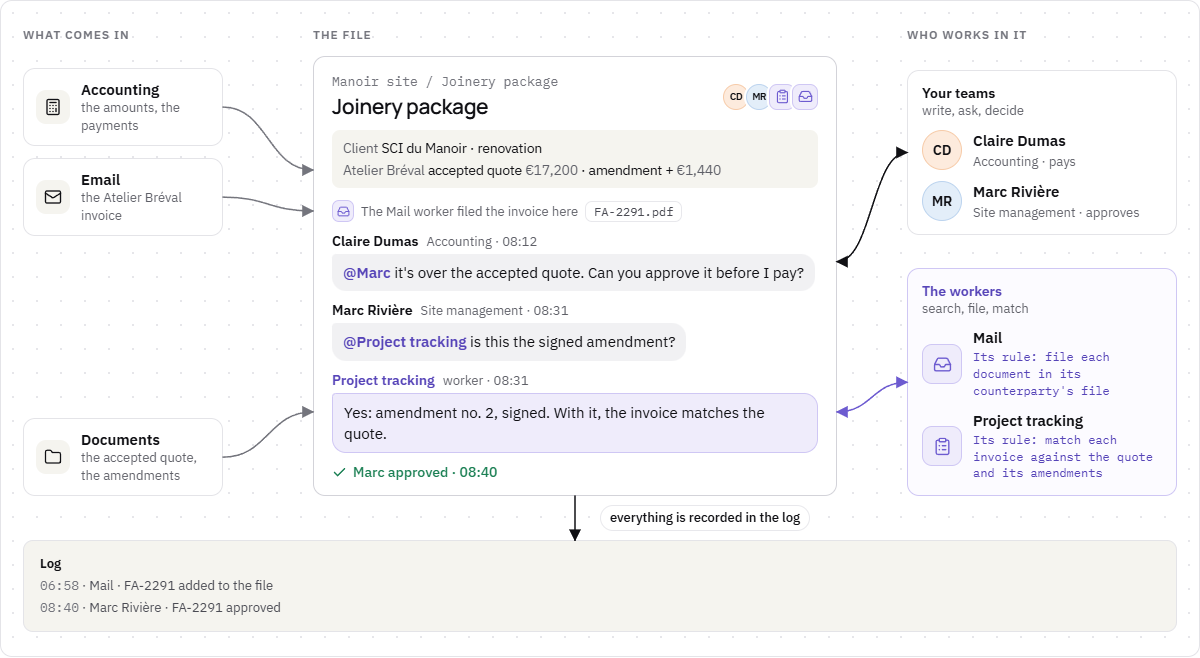
What comes in is filed there. Your teams and the workers work in it together. What is done stays there.

The diagram of the file. On the left, what comes in: accounting (the amounts, the payments), email (the invoice) and the documents (the accepted quote, the amendments), each linked to its place in the file for the joinery package. In the middle, the file’s thread: Claire Dumas asks Marc Rivière to approve the invoice, Marc asks the Project tracking worker, which answers that it is amendment no. 2, signed, and Marc approves. On the right, who works in it: your teams, who write, ask and decide, and the Mail and Project tracking workers, each with its rule. At the bottom, the log of what has been done.

From a person to a worker, from a worker to a person, from one worker to another, between colleagues: everything goes through the same place, and nobody waits for anybody.

Example, fictitious data.
  • 01 · organisation

    Who does what, written once

    We put your chains, your rules and your thresholds in writing. Each worker has its job description: what it does, what it never does, who it hands over to.

    The risk removedRules that live in one person's head.

  • 02 · communication

    One place, one file

    No more documents circulating by email, no more context to explain again. Your teams and the workers read and write in the same place.

    The risk removedThe version lying around, the validation left waiting.

  • 03 · handover

    The workers pass the baton

    A worker hands over through a task, to a person or, if you allow it, to the next worker. Nobody has to chase: a human steps in only to decide.

    The risk removedInternal chasing to find out where a file stands.

A file, up close.

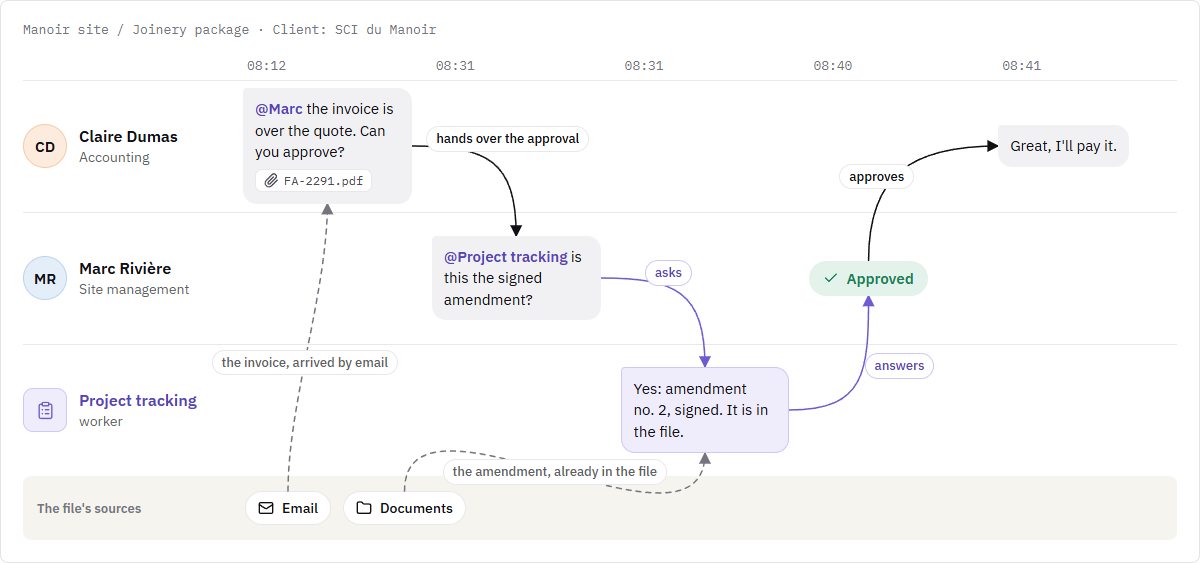
An invoice is over the quote. Nobody hunts for the right email or the right version: the question, the document and the answer are in one place.

  1. Between colleagues Claire writes to Marc in the file, with the invoice attached. The task is now his.
  2. To a worker Marc mentions the Project tracking worker, which searches the file.
  3. The worker answers In the thread, citing the amendment it found in the file.
  4. The decision stays human Marc approves. The task closes, and everything stays in the file and in the log.
The same file in four handovers, from 08:12 to 08:41, with one line for Claire Dumas, one for Marc Rivière and one for the Project tracking worker. Claire hands the approval over to Marc; Marc asks the worker; the worker answers that the amendment is already in the file; Marc approves; Claire pays. The invoice arrived by email, the amendment is filed with the documents.

The worker searches, people decide. Everything is recorded in the log.

Example, fictitious data.

How we work

Written rules, not conversations

Each step has its rule, written in French: what it does, what it never does, who it hands over to.

We explain once, in writing. The worker and the team read the same rule, in the same place. The rules live in the job description, in French: you change them yourself, without any development.

The risk removedThe agent that decides what it was not meant to decide.

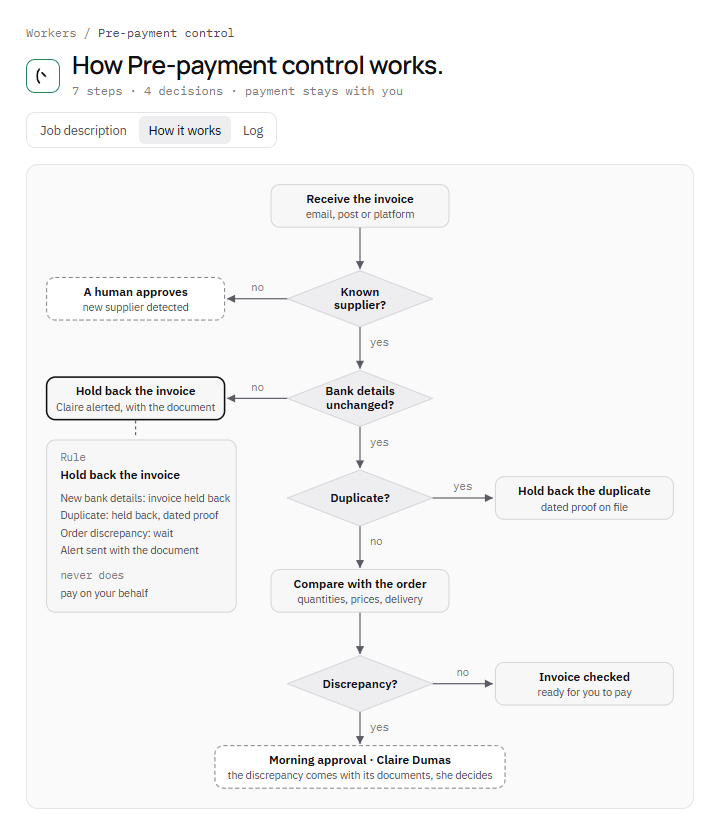
The flowchart of the Pre-payment control worker. When an invoice arrives, it checks the supplier, the bank details, duplicates and the order; a change of bank details holds back the invoice and raises an alert with the document, and each discrepancy goes back to a person for a decision.
Example, fictitious data

While your team is away

Overnight, they work.

The workers we install process, at the time you set, what arrived during the day. They disturb nobody: anything that needs a decision waits for the morning, with the file prepared.

  • They read the documents that have arrived and file them.
  • They match each invoice against its order or quote.
  • They check invoices before payment.
  • They prepare the files awaiting a decision.

When you arrive

In the morning, you decide.

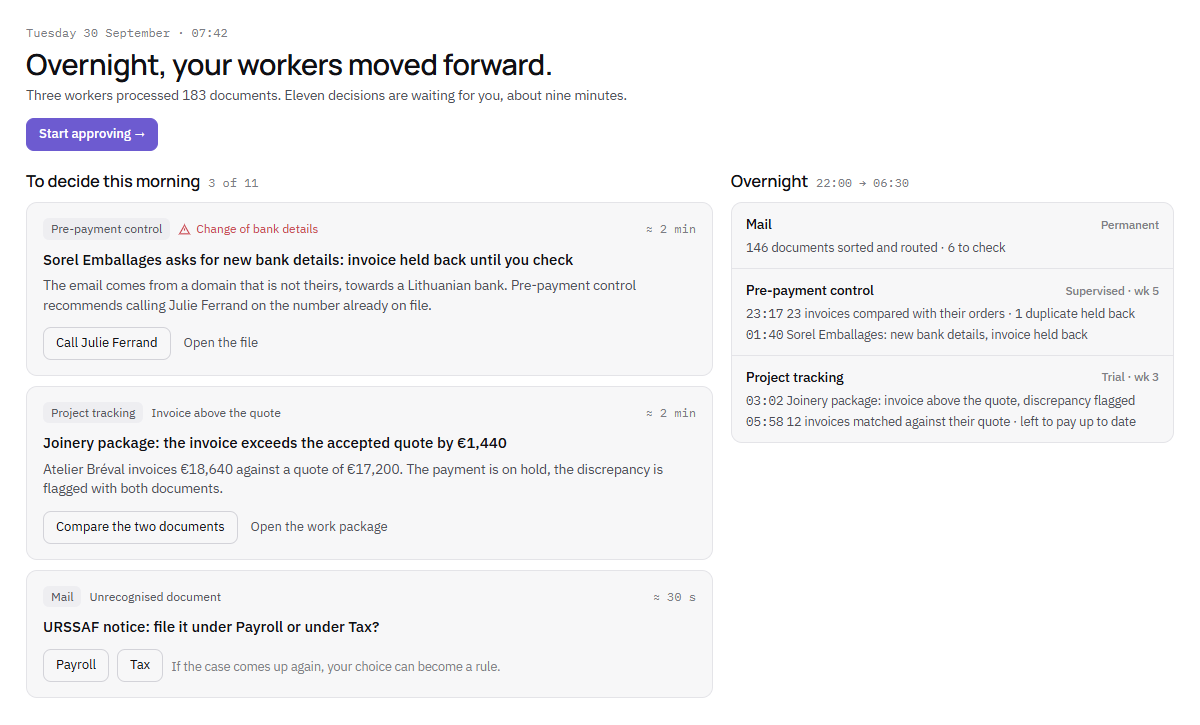
The decisions awaiting you are on a single screen, the most urgent first, each with its file. It only disturbs you to decide.

  • You validate what it has prepared.
  • You settle the doubts.
  • You read what has been done.
The morning screen. Eleven decisions are waiting, about nine minutes; three are detailed: a change of bank details at Sorel Emballages, invoice held back; an invoice for the joinery package above the accepted quote; a document the Mail worker cannot classify. Alongside, the overnight report of the three workers.
Example, fictitious data

The risk removedThe validation left waiting while everyone waits.

We write your processes. Our workers run them. Your teams decide

Promises and risks

What it secures

What we promise, and the risk each promise removes
What we promiseThe risk removed
Written rules, step by stepThe agent that decides what it was not meant to decide
Human validation before anything is sentThe unfortunate email to a major customer
A dated log of everything that has been doneThe file nowhere to be found when a dispute or an inspection comes
An alert on any change of bank detailsFake supplier fraud
Two weeks of trial on your real files, without sending anythingThe project that never goes live
A written job description for each chainDependence on the person who leaves with everything in their head
A report every weekFlying blind
We install and we operateThe tool that is bought but never connected

The risks removed

What the method spares you

  • The project that never goes live

    One dated step per week, made permanent in week six. Not a year-long project.

  • Going live blind

    Two weeks of trial without sending anything, then a week in which every action is validated. You judge on the evidence.

  • Exceptions discovered by a customer

    They appear during the trial period, while nothing goes out yet.

  • The team that discovers the tool on launch day

    It writes the rules, compares, validates. It knows the worker before the worker works on its own.

To get started

Where do you start?

With an audit, if you first want to know where AI will really pay off for you. With a custom worker, if you already know where things get stuck: the Diagnostic measures the real figure in your company.

Request a call back